What to Check Before Buying a Social Media Account — The Complete Checklist
You have found a listing that looks promising. The follower count seems good, the price seems fair, and you are tempted to move forward quickly before someone else grabs it. This is exactly the moment where buyers either make a smart purchase or an expensive mistake.
The accounts that turn out to be genuinely valuable and the accounts that turn out to be a waste of money often look identical at first glance. The difference is entirely in what you check before you pay. This guide gives you the complete, practical checklist to run through before buying any YouTube channel, Instagram page, TikTok account, or Facebook page — so you know exactly what you are paying for.
Why a Checklist Matters More Than Instinct
It is tempting to make a quick decision based on how a listing feels — a big follower number, a nice-looking profile, a seller who seems friendly and responsive. But feelings are not data, and sellers who misrepresent their accounts are often very good at creating a positive first impression.
A systematic checklist removes guesswork from the equation. Every point below exists because it addresses a specific, common way that buyers lose money or end up with an account that does not deliver what they expected. Go through these in order, every time, regardless of how confident you feel about a listing.
1. Check Engagement — Not Just Follower Count
This is the single most important check, and it applies to every platform without exception.
Follower or subscriber count is what most buyers look at first, but it is fundamentally a vanity metric. What actually determines whether an account is valuable is how many of those followers genuinely interact with content.
Look at the likes, comments, shares, or views on recent posts and compare them to the total follower count. A healthy, genuinely engaged account shows a consistent, proportional level of interaction. If an account has 50,000 followers but recent posts get only a handful of comments and minimal engagement, the audience is likely inactive, fake, or was never genuinely interested to begin with.
Be specific in your comparison. Ask the seller directly for analytics or insights data rather than relying on what is visible publicly, since public numbers can sometimes be incomplete or misleading on their own.
2. Sample the Actual Followers
Beyond the engagement numbers, take the time to look at who is actually following the account. Scroll through a sample of the follower list and check for warning signs — profiles with no posts, no profile picture, gibberish usernames, or accounts that follow thousands of profiles while having almost no followers themselves.
A high concentration of these characteristics signals purchased or bot followers. A genuine, organically built audience looks varied and human — different profile styles, different activity levels, different posting patterns. Bot networks tend to look suspiciously uniform.
3. Review the Account's Content and Activity History
Scroll through the full history of what has actually been posted. You are looking for a few specific things here.
Consistency. Does the content stay within a coherent niche, or does it jump between unrelated topics? Frequent niche changes can indicate the account has been resold multiple times or that the audience does not have a clear, stable reason to stay engaged.
Genuine activity over time. A long, steady history of posting demonstrates real effort and engagement built gradually. Be cautious of accounts that show long periods of complete inactivity followed by a sudden burst of posts right before being listed for sale — this pattern often indicates an attempt to make a dormant account look more active than it really is.
Quality and tone. Does the existing content align with what you intend to do with the account after purchase? If you plan to shift direction significantly, understand that this often causes some of the existing audience to lose interest, since they followed for the original content.
4. Check for Past Policy Violations or Restrictions
Ask directly whether the account has ever faced any strikes, content removals, restricted reach, or other policy actions. An account with a clean standing carries far less risk than one with a history of violations, even if those violations happened under the previous owner.
This matters because platforms increasingly use automated systems that track account history over time. A troubled past does not always disappear after a change in ownership, and you want to know exactly what you are inheriting before you commit.
5. Verify Niche and Audience Alignment With Your Goals
An account is only as valuable as how well it fits what you actually want to do with it. A large account with an audience interested in cooking content is not automatically valuable to you if your goal is to promote financial services. Check the actual audience demographics and interests, not just the raw size, and make sure there is a genuine match with your intended use.
This is also where comparing multiple similar listings helps. Looking at several accounts in the same niche and price range gives you a much better sense of what realistic engagement and pricing actually look like, rather than evaluating a single listing in isolation.
6. Confirm Full Transferability
This is one of the most overlooked checks, and it can completely undermine an otherwise good purchase. Make absolutely sure that you will receive full, exclusive control of the account — not just temporary access.
This means confirming you will receive the original email used to create the account where applicable, and that you will be able to change the password, recovery email, phone number, and security settings to your own. Some sellers retain hidden access through old recovery details they do not disclose, which can allow them to reclaim the account even after a sale appears complete.
Ask this question directly and explicitly before paying anything: "Will I receive full ownership, including the original email and the ability to change all security and recovery details?" A seller who hesitates or gives a vague answer is showing you exactly the risk you are trying to avoid.
7. Confirm How the Transfer Will Actually Happen
Different platforms transfer ownership in different ways, and understanding the specific method for the platform you are buying on tells you what to expect and what is normal.
YouTube channels transfer through Google's Brand Account ownership system, which includes a mandatory waiting period before full ownership transfers. Facebook pages transfer through admin rights being granted and then confirmed, without that same waiting period. TikTok and Instagram accounts typically transfer through a secure handover of login credentials, since neither platform offers an official ownership transfer mechanism the way YouTube does.
Knowing this in advance means you will not be confused or alarmed by a process that is actually completely standard for that platform, and it also means you can spot when a seller is proposing something unusual or risky that does not match the normal transfer method.
8. Make Sure Your Payment Is Protected
This is the check that protects you regardless of how well everything else goes. Never send payment directly to a seller through a method with no protection — direct bank transfer, cryptocurrency sent straight to a wallet, or any payment app without buyer protection built in.
Use a marketplace with escrow protection, where your payment is held securely and only released to the seller once you have confirmed the transfer is complete and the account is fully secured under your control. This single decision protects you from the most common and most damaging risk in the entire process: paying and receiving nothing in return.
9. Document the Agreement and Keep Communication on Record
If you are negotiating specific terms with a seller — what exactly is included, the exact price, any conditions of the sale — make sure these details are written down clearly, ideally within the messaging system of the platform you are using rather than through external channels.
This documentation matters if any dispute arises later. A clear written record of what was agreed protects both you and the seller, and most reputable marketplaces use this exact record as the basis for resolving any disagreement.
10. Have a Plan for Securing the Account Immediately After Purchase
The checklist does not end once you have paid and the transfer is in motion. The moment you receive access, you should already know exactly what you are going to do: change the password, update the linked email to your own, update the phone number, and enable two-factor authentication, in that order, before doing anything else with the account.
Having this plan ready before the transfer happens means there is no delay or confusion in the critical window right after you gain access — which is exactly when the account is most vulnerable to being reclaimed if security is not locked down quickly.
A Quick Summary — The Checklist at a Glance
Before you pay for any social media account, confirm each of these:
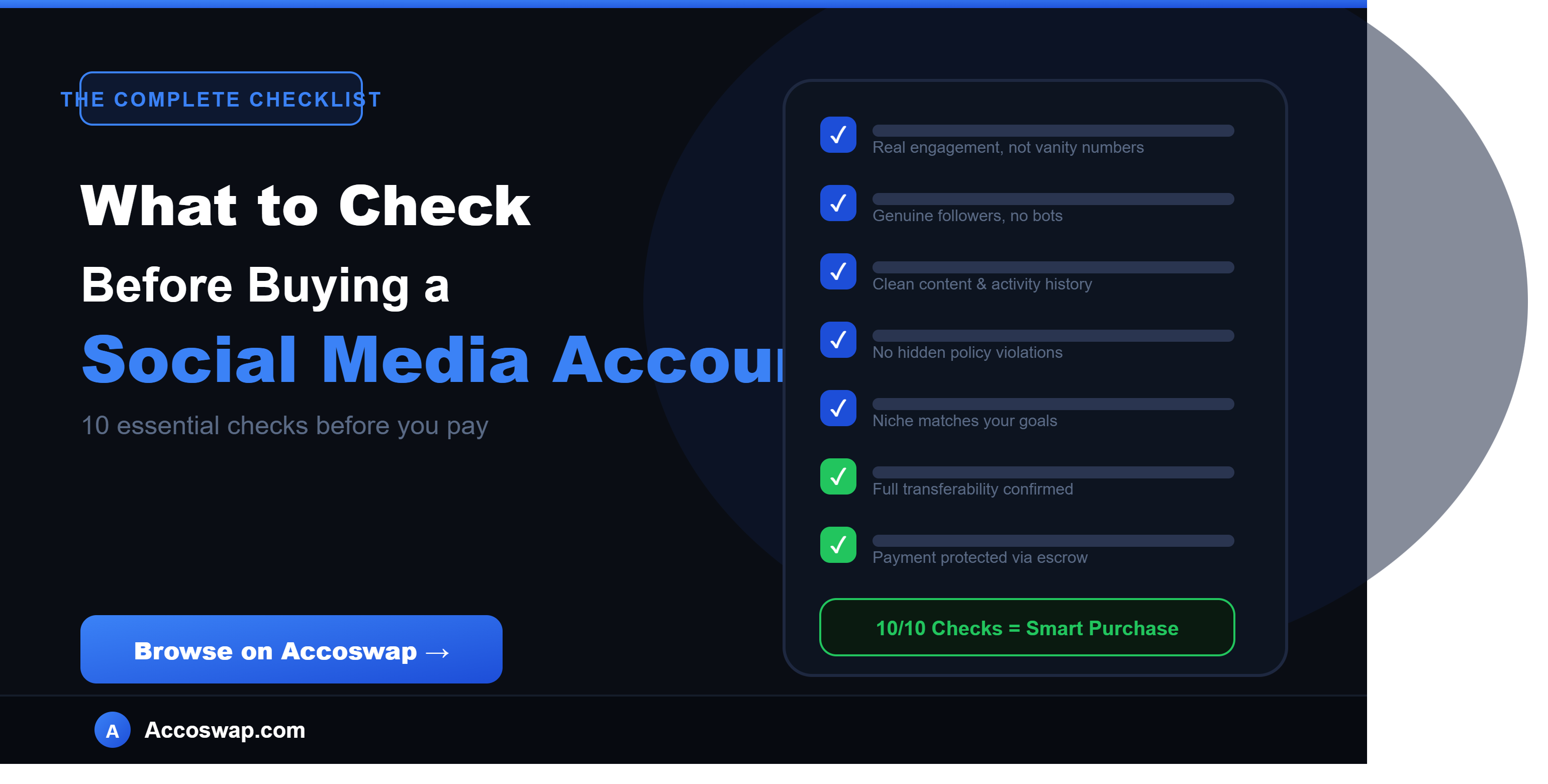
Engagement is proportional to follower count, not just impressive in isolation. The actual followers look genuine when sampled, not bot-like or inflated. The content history is consistent, genuine, and free of suspicious activity spikes. There is no history of policy violations or restrictions you were not told about. The niche and audience genuinely align with your goals. You will receive full transferability, including the original email and all recovery details. You understand exactly how the transfer process works for that specific platform. Your payment is protected through escrow, not sent directly to the seller. The agreement terms are documented clearly within the platform. You have a clear plan to secure the account the moment you receive access.
If you can confidently check every item on this list, you are buying carefully and protecting yourself from the most common and costly mistakes in this market.
How Accoswap Supports This Checklist
Several of these checks are built directly into how Accoswap's marketplace functions. Every transaction is protected through escrow, meaning your payment is never released to the seller until the transfer is verified and you confirm you have full control. Communication happens through the platform's messaging system, creating a clear record if any dispute becomes necessary. And the transfer process itself follows the correct, platform-specific method for each type of account — whether that is the Google Brand Account system for YouTube, admin rights for Facebook, or a secure credentials handover for TikTok and Instagram.
The remaining checks — engagement quality, follower authenticity, content history, and niche alignment — are things only you can evaluate properly for the specific account you are considering, which is exactly why this checklist exists.
Frequently Asked Questions
What is the single most important thing to check before buying?
Engagement relative to follower count. This single check exposes the majority of inflated or low-value accounts before you spend any money.
Engagement relative to follower count. This single check exposes the majority of inflated or low-value accounts before you spend any money.
How do I know if followers are fake?
Sample the actual follower list and look for profiles with no posts, no profile picture, or unusual usernames. Compare engagement on recent posts to the total follower count — a significant mismatch is a strong warning sign.
Sample the actual follower list and look for profiles with no posts, no profile picture, or unusual usernames. Compare engagement on recent posts to the total follower count — a significant mismatch is a strong warning sign.
What if the seller refuses to answer my questions?
Treat this as a serious warning sign. A genuine seller with a legitimate account has no reason to avoid answering reasonable questions about engagement, history, or transferability.
Treat this as a serious warning sign. A genuine seller with a legitimate account has no reason to avoid answering reasonable questions about engagement, history, or transferability.
Is it normal for account transfers to take several days?
For some platforms, yes. YouTube channel transfers specifically involve a mandatory multi-day waiting period as part of Google's security process, which is completely standard and not a sign of a problem.
For some platforms, yes. YouTube channel transfers specifically involve a mandatory multi-day waiting period as part of Google's security process, which is completely standard and not a sign of a problem.
Should I ever skip escrow if the seller seems trustworthy?
No. Escrow protection exists precisely because trustworthiness cannot be verified in advance with certainty. Even well-intentioned deals can go wrong, and escrow protects you regardless of how the seller seems.
No. Escrow protection exists precisely because trustworthiness cannot be verified in advance with certainty. Even well-intentioned deals can go wrong, and escrow protects you regardless of how the seller seems.
What should I do immediately after receiving the account?
Change the password, update the linked email to your own, update the phone number, and enable two-factor authentication, in that order, before doing anything else with the account.
Change the password, update the linked email to your own, update the phone number, and enable two-factor authentication, in that order, before doing anything else with the account.
Final Thought
Buying a social media account can be a genuinely smart move when the account is right and the process is handled carefully. The difference between a smart purchase and a costly mistake almost always comes down to whether the buyer ran through a proper checklist before paying, rather than relying on a quick impression.
Take the time to go through these checks every single time, regardless of how good a listing looks at first glance. The few extra minutes this takes is the cheapest insurance you will ever buy.
On Accoswap
Ready to act on this guide?
Tags: