Research complete — yeh competitors ke escrow models hain. Ab AccoSwap ke accurate process ke saath complete, comprehensive escrow guide article likhta hun jo sab platforms cover karega:
📌 Admin Panel Mein Yeh Fill Karo:
Blog Title:
How Does Escrow Work When Buying or Selling Social Media Accounts?SEO Title:
How Does Escrow Work for Social Media Accounts? | Complete Guide | AccoswapSlug:
how-does-escrow-work-social-media-accountsSEO Description:
Confused about how escrow protects you when buying or selling social media accounts? This complete guide explains exactly how escrow works for YouTube, Facebook, TikTok, and Instagram on Accoswap.Tags:
how does escrow work, social media escrow, escrow social media accounts, escrow protection, buy sell accounts safely, escrow explainedCategory:
Trust & Safety📄 CONTENT — Copy & Paste:
How Does Escrow Work When Buying or Selling Social Media Accounts?
If you have spent any time looking into buying or selling a YouTube channel, TikTok account, Instagram page, or Facebook page, you have probably come across the word "escrow" again and again. Every legitimate marketplace mentions it. Every safety guide tells you to use it. But if you have never actually been through the process, it can feel a little abstract — what exactly is escrow, and how does it actually protect you?
This guide breaks it down completely. By the end, you will understand exactly what escrow is, why it exists, how the process works step by step, and how it specifically applies to each major platform — because YouTube, Facebook, TikTok, and Instagram each transfer ownership in slightly different ways.
What Is Escrow, in Plain Terms?
Escrow is a secure middleman system. Instead of a buyer sending money directly to a seller and hoping everything works out, the buyer's payment is held safely by a neutral third party — the escrow service — until the account has been successfully transferred and the buyer confirms they have received exactly what they paid for. Only then is the payment released to the seller.
Think of it like a referee standing between two people making a trade. The buyer hands their payment to the referee, not the seller. The seller hands over the account, with the referee verifying everything along the way. Only once both sides have done their part does the referee release the money. Neither side can walk away with both the money and the account, and neither side can be left empty-handed.
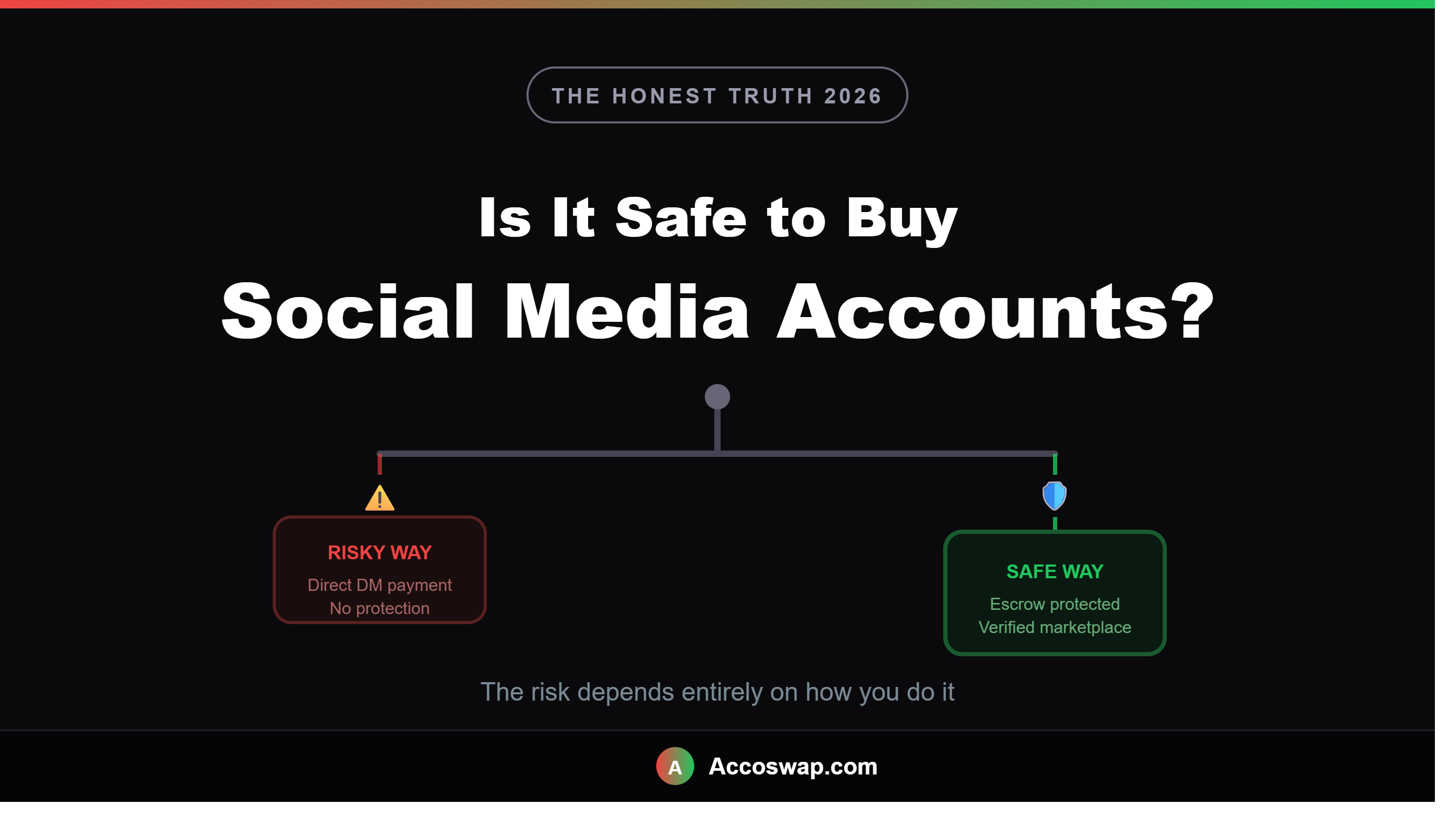
This is fundamentally different from a direct deal, where a buyer sends payment straight to a seller through PayPal, crypto, or bank transfer. In a direct deal, once the money is sent, the buyer has zero leverage and zero protection if the seller decides not to deliver, delivers something different from what was promised, or simply disappears.
Why Escrow Exists — The Problem It Solves
Buying and selling digital accounts is fundamentally different from buying a physical product. There is no shipping tracking number, no physical proof of delivery, and the "product" itself — login access or ownership rights — can be revoked or reclaimed after the fact in ways a physical item cannot.
This creates a unique trust problem. If the buyer pays first, the seller could simply not deliver. If the seller delivers first, the buyer could refuse to pay or claim a chargeback after receiving access. Someone has to go first, and without protection, that person is taking on all the risk.
Escrow solves this by removing the need for either side to trust the other directly. The buyer's money is secured before the seller does anything. The seller's account is verified before any money moves. Both sides are protected at every stage, and neither one can cheat the other.
How Escrow Generally Works — The Common Flow
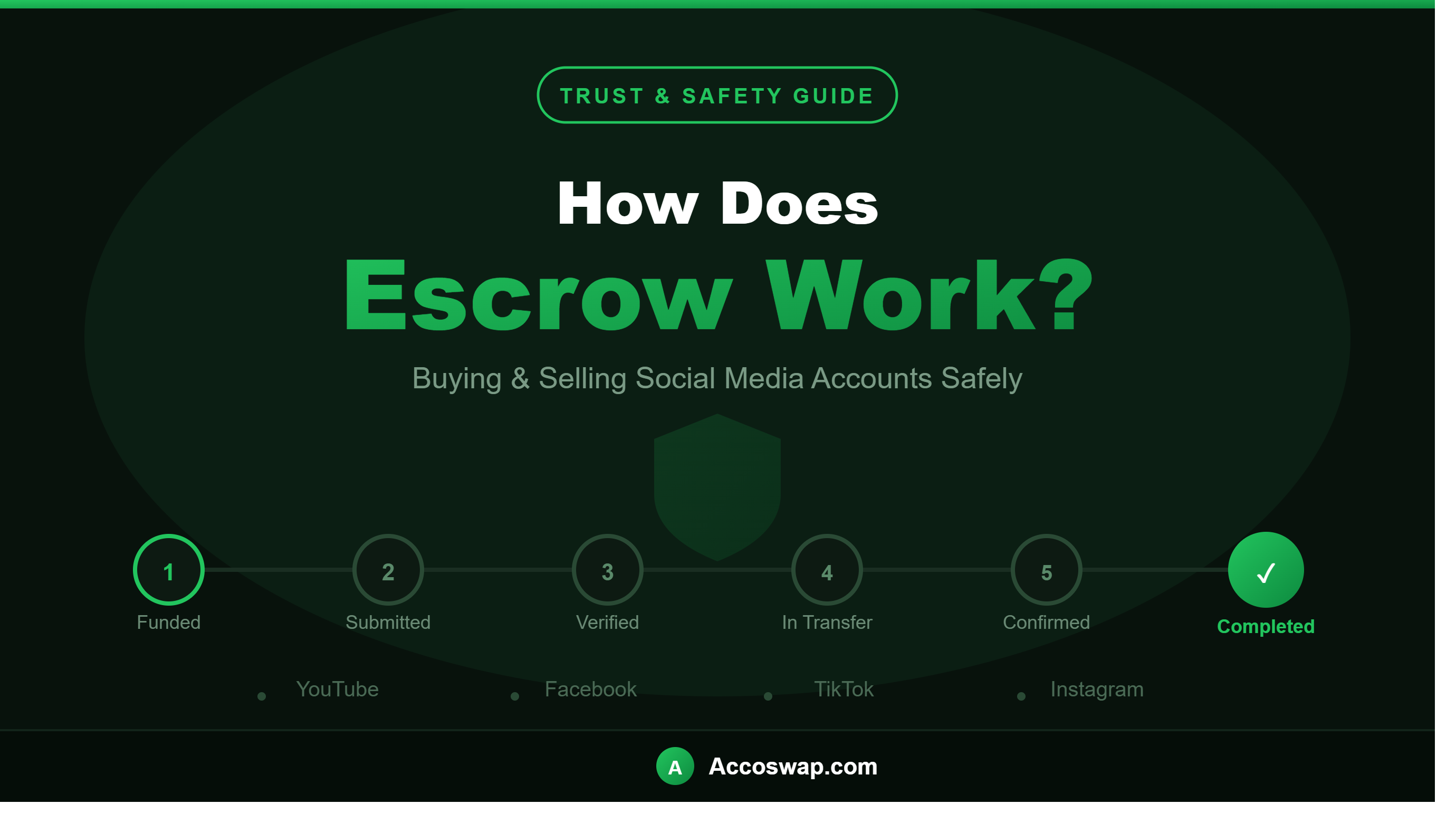
While the exact steps differ slightly by platform, every escrow transaction on Accoswap follows the same general journey from start to finish:
Funded → Submitted → Verified → In Transfer → Confirmed → Completed
Here is what happens at each stage in practice.
Browse and buy. The buyer finds a listing they want and either purchases it directly or sends an offer. Once the offer is accepted, an escrow is created for that specific transaction.
Fund the escrow. The buyer pays. This money is now locked safely in escrow — not sitting in the seller's account, not accessible to anyone yet. At checkout, the buyer also provides any platform-specific details needed for the transfer, such as a Gmail address for a YouTube channel or a Facebook profile link for a Facebook page.
The seller transfers. The seller hands over the account using the appropriate, safe method for that specific platform — either an ownership invitation system or secure login credentials, depending on what the platform supports.
Escrow and/or the buyer verifies. Accoswap and the buyer confirm that access to the account has been properly established and that everything matches what was listed.
The buyer confirms. Once the buyer has full, secure control of the account, they confirm this on their escrow page.
Funds are released. The escrow is marked complete, and the seller's payment is released to their Accoswap balance. Both sides can then leave a review of the transaction.
Every escrow page also includes a "Chat with Escrow Support" button for help at any point, the ability to message the other party directly, and the option to open a dispute if something does not go as expected.
Why the Process Differs by Platform
Here is something worth understanding clearly: YouTube, Facebook, TikTok, and Instagram each have completely different systems for transferring ownership, so escrow has to adapt to each one. There is no single universal "transfer button" that works the same way across every platform. Some use official ownership permission systems built into the platform itself. Others rely on a secure handover of login credentials. Understanding which method applies to your platform helps you know exactly what to expect.
How Escrow Works for YouTube Channels
YouTube channels are transferred through Google's official ownership system, which includes a mandatory security feature that affects the timeline.
The process flow looks like this: Funded → Seller Added Escrow → Escrow Verified → Buyer Invited as Manager → 7-Day Timer → Completed
After the buyer's payment is secured, the seller adds Accoswap's official escrow email as an owner on their YouTube channel through the Google Brand Account settings — not through YouTube Studio directly. Once escrow verifies the channel details and accepts ownership, the buyer's Gmail address (provided at checkout) is invited to the channel as a Manager.
Here is the important part: Google requires a mandatory 7-day security waiting period before any new owner can be elevated to full ownership. This is not an Accoswap rule — it is Google's own policy, designed to prevent unauthorized account takeovers. During those 7 days, the buyer has Manager access to review the channel, but full ownership has not yet transferred.
If the buyer does not click to accept the invitation within 24 hours, Accoswap automatically accepts it on their behalf so the transaction is never left stuck. After the 7-day period completes, escrow makes the buyer the Primary Owner, removes the seller's access entirely, and releases the payment. This entire process is handled automatically — sellers should never attempt to manually make the buyer the primary owner themselves, since escrow manages that final step after the waiting period.
How Escrow Works for Facebook Pages
Facebook pages transfer differently from YouTube channels, and notably, there is no multi-day waiting period involved.
The process flow looks like this: Funded → Seller Added Escrow → Buyer Notified → Buyer Confirmed → Completed
After payment is secured in escrow, the seller adds Accoswap's official escrow Facebook profile as a Page Admin. The seller also removes the page from their Business Portfolio if it was linked to one, which is necessary for a clean transfer with no lingering ties to the seller's business account.
Once escrow verifies access, the buyer — who provided their Facebook profile URL at checkout — is added as a Page Admin. The buyer checks that they have full admin and ownership access and confirms this on their escrow page. Because there is no waiting period requirement for Facebook the way there is for YouTube, the transfer completes promptly once both sides confirm. Escrow then removes any other admins from the page, finalizing the transfer and releasing payment to the seller.
How Escrow Works for TikTok and Instagram
TikTok and Instagram accounts are transferred through a secure login credentials handover rather than an ownership permission system, since neither platform offers the kind of official ownership transfer tools that YouTube and Facebook provide.
The process flow looks like this: Funded → Seller Submitted Details → Buyer Secured Account → Completed
After payment is secured, the seller is responsible for cleaning the account before submitting anything — removing passkeys, all linked devices, any third-party linked accounts, and disabling two-step verification. This step matters enormously: if these security items are not removed and the account is later recovered by the original owner, the buyer can open a dispute, which may lead to the seller's account being restricted.
Once cleaned, the seller submits the login details securely through the escrow page — username or email plus password. For Instagram specifically, this also includes the original email used to create the account along with its password, since that original email is critical for the buyer to fully secure ownership afterward.
The buyer receives these credentials on their escrow page once submitted. Some listings even offer instant delivery, where details appear immediately after funding. The buyer then logs in and immediately secures the account — changing the email, password, and all security settings. If an OTP or verification code is needed during this process, the buyer can request it from the seller directly through Accoswap's messaging system. Only once the account is 100% under the buyer's control do they click "I Secured The Account," which completes the escrow and releases payment to the seller.
What Happens If Something Goes Wrong — Disputes
Escrow exists precisely for situations where something does not go as planned. A dispute can be opened on the escrow page any time while the escrow is active — from the moment it is funded through to the final handover. Once a dispute is opened, the Accoswap escrow team reviews both sides of the situation and decides on a fair outcome, which may mean completing the transfer or refunding the buyer.
Here are some common situations and what to do:
If the seller did not transfer the account or delivered the wrong one, open a dispute — the buyer is refunded if the issue is not resolved. If an account is recovered by the previous owner after handover, open a dispute with proof, since this can lead to the seller's account being restricted or banned. If you need an OTP or verification code during a live transfer, message the other party directly through the in-platform chat. If you are simply unsure about a step in the process, use the "Chat with Escrow Support" button available on every escrow page.
The Golden Rules of Using Escrow Safely
A few principles apply across every platform and every transaction, and following them is what keeps the entire system working as intended.
Never deal outside of escrow. Only transactions that go through Accoswap's escrow system are protected. Any agreement to pay or transfer outside the platform — no matter how trustworthy the other party seems — removes all protection instantly.
Buyers should secure the account immediately. As soon as access is received, change the email and password before confirming anything. Confirming too early, before security is locked down, removes your leverage if something is later found to be wrong.
Sellers should clean the account before handing it over. Remove devices, passkeys, two-factor authentication, and any linked accounts before submitting details. This protects you from disputes that arise from incomplete handovers.
Only confirm when you are completely sure. Confirming an escrow transaction releases the funds. Take the time you need to verify everything before clicking confirm.
Keep all communication inside the platform. Conversations through the in-platform chat serve as your evidence if a dispute becomes necessary. Conversations that happen elsewhere cannot be used to support your case.
Frequently Asked Questions
Is escrow really necessary, or can I just trust the other person?
Escrow exists because trust alone is not verifiable in a digital transaction. Even well-intentioned deals can go wrong due to miscommunication, technical issues, or a change of heart. Escrow removes the need to rely on trust by holding the payment securely until both sides have fulfilled their part.
Escrow exists because trust alone is not verifiable in a digital transaction. Even well-intentioned deals can go wrong due to miscommunication, technical issues, or a change of heart. Escrow removes the need to rely on trust by holding the payment securely until both sides have fulfilled their part.
Does escrow cost extra?
Escrow is built into the transaction process on Accoswap and protects both the buyer and seller throughout. The specific cost structure is outlined clearly during checkout before you commit to a purchase.
Escrow is built into the transaction process on Accoswap and protects both the buyer and seller throughout. The specific cost structure is outlined clearly during checkout before you commit to a purchase.
How long does an escrow transaction take?
This depends on the platform. Facebook, TikTok, and Instagram transfers typically complete within a short timeframe once both sides act promptly. YouTube channel transfers take longer because of Google's mandatory 7-day security waiting period, which applies regardless of which escrow service is used.
This depends on the platform. Facebook, TikTok, and Instagram transfers typically complete within a short timeframe once both sides act promptly. YouTube channel transfers take longer because of Google's mandatory 7-day security waiting period, which applies regardless of which escrow service is used.
What if the seller disappears after I pay?
Your payment remains locked in escrow and is never released until the transfer is verified and you confirm receipt. If the seller fails to deliver, you can open a dispute, and the situation is reviewed by the escrow team.
Your payment remains locked in escrow and is never released until the transfer is verified and you confirm receipt. If the seller fails to deliver, you can open a dispute, and the situation is reviewed by the escrow team.
Can I cancel an escrow transaction?
If a transfer has not been completed and a genuine issue arises, opening a dispute allows the escrow team to review the situation, which can result in a refund if the seller failed to deliver as agreed.
If a transfer has not been completed and a genuine issue arises, opening a dispute allows the escrow team to review the situation, which can result in a refund if the seller failed to deliver as agreed.
What is the biggest risk of not using escrow?
Without escrow, whoever acts first — paying or transferring — has no protection if the other party does not follow through. This is exactly how the majority of social media account scams happen, and it is entirely avoidable by using a proper escrow system.
Without escrow, whoever acts first — paying or transferring — has no protection if the other party does not follow through. This is exactly how the majority of social media account scams happen, and it is entirely avoidable by using a proper escrow system.
Why This Matters More Than People Realize
Every year, countless buyers and sellers lose money or accounts in direct deals made through Telegram groups, DMs, and informal forums with no protection whatsoever. The pattern is always the same — someone goes first, trusting the other side, and ends up with nothing. Escrow exists specifically to eliminate this risk entirely, regardless of which platform the account is on.
Whether you are buying a YouTube channel that comes with a 7-day Google waiting period, a Facebook page that transfers promptly through admin rights, or a TikTok or Instagram account that moves through a secure credentials handover, the underlying principle is the same: your money or your account is never exposed without protection at any stage.
Ready to buy or sell with complete peace of mind?
On Accoswap
Ready to act on this guide?
Tags: