Bahut valuable research mila — yeh confirm karta hai ke platforms officially yeh transfers allow nahi karte, lekin practically yeh market existing hai. Main is article mein honest, balanced approach lunga. Ab complete article likhta hun:
📌 Admin Panel Mein Yeh Fill Karo:
Blog Title:
Is It Safe to Buy Social Media Accounts? The Honest Truth in 2026SEO Title:
Is It Safe to Buy Social Media Accounts in 2026? | Honest Guide | AccoswapSlug:
is-it-safe-to-buy-social-media-accounts-2026SEO Description:
Wondering if it's safe to buy social media accounts in 2026? This honest guide covers the real risks, how escrow protects you, and how to buy YouTube, Instagram, TikTok and Facebook accounts safely.Tags:
is it safe to buy social media accounts, buying social media accounts safe, social media account scams, buy accounts safely, social media marketplace risksCategory:
Trust & Safety📄 CONTENT — Copy & Paste:
Is It Safe to Buy Social Media Accounts? The Honest Truth in 2026
This is the question almost everyone asks before they buy their first YouTube channel, TikTok account, Instagram page, or Facebook page — and it deserves an honest answer, not a sales pitch.
The truth is more nuanced than a simple yes or no. Buying social media accounts carries real risks that you should understand clearly. But it also is not the reckless gamble that scare-tactic articles sometimes make it out to be. This guide gives you the complete, balanced picture — what the actual risks are, why they exist, and exactly how to minimize them so you can make an informed decision.
The Honest Answer — It Depends Entirely on How You Do It
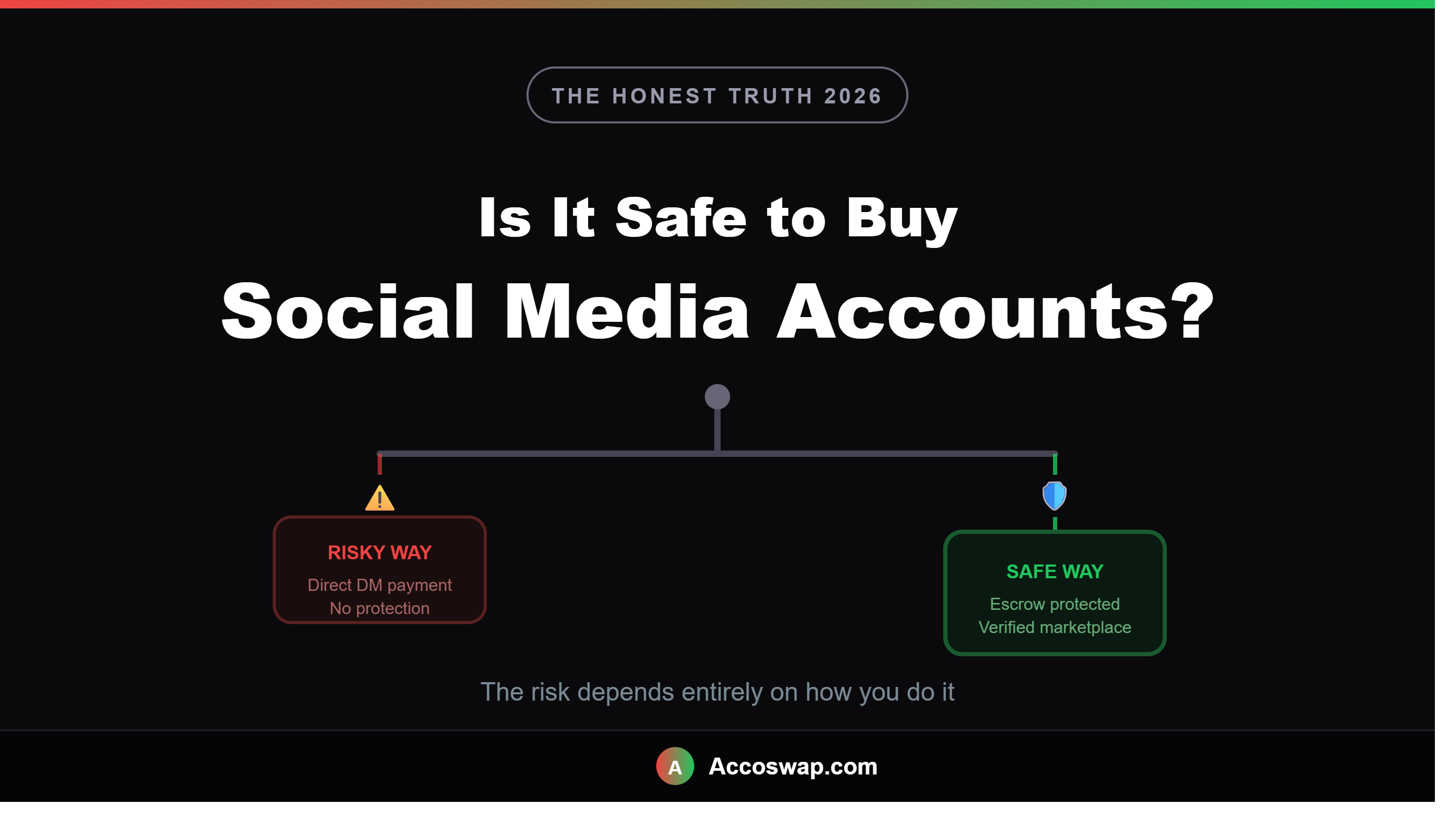
Buying a social media account done carelessly — through a random DM, a Telegram seller, or a direct payment with no protection — is genuinely risky. People lose money this way every single day.
Buying a social media account done correctly — through a verified marketplace, with proper verification, and with escrow protection — is a fundamentally different experience. The underlying activity is the same, but the risk profile changes completely based on the method.
So the real question is not "is it safe" in the abstract. It is "am I doing this the safe way or the risky way." This guide will make sure you understand the difference clearly.
What Platforms Actually Say About This
It is worth being upfront about something important: most major platforms, including Instagram, Facebook, and TikTok, do not officially permit account ownership transfers between unrelated parties in their terms of service. This is true industry-wide, regardless of which marketplace or escrow service you use.
This does not mean account transfers do not happen — they happen constantly, across a massive global market. What it means is that the transfer itself happens outside the platform's official blessing, which is exactly why the method you use to secure the account afterward matters so much. A clean, properly secured transfer significantly reduces the practical risk involved, even though the platforms themselves do not formally endorse the practice.
YouTube is somewhat different here, since Google's Brand Account system does provide an official mechanism for transferring channel ownership between Google accounts, which is why YouTube channel transfers tend to be more stable and predictable than transfers on platforms without a similar built-in system.
The Real Risks — Laid Out Honestly
Let us go through the actual risks that exist in this space, without sugar-coating them.
Risk 1: Getting Scammed Out of Your Money
This is the single most common risk, and it is entirely preventable. The scam pattern is always the same: a buyer sends payment directly to a seller — through PayPal, crypto, or bank transfer — and the seller either never delivers the account or disappears immediately after receiving payment. Without any third party holding the money, the buyer has zero recourse.
This risk exists almost exclusively in direct, unprotected deals. It is largely eliminated when a transaction goes through proper escrow, where payment is held securely and only released once the transfer is verified complete.
Risk 2: Fake Followers and Inflated Metrics
Many sellers inflate their account's apparent value using bots or purchased followers. A buyer who does not verify engagement properly can end up paying a premium price for an account that is, in practice, almost worthless because the audience is not real.
This risk is mitigated through careful verification — checking engagement relative to follower count, sampling the actual follower list for bot-like characteristics, and never relying on raw numbers alone.
Risk 3: Account Recovery by the Previous Owner
This is one of the more serious risks specific to digital account transfers. If the buyer does not fully secure the account after the transfer — changing the email, password, phone number, and security settings — the original owner can sometimes recover access later, even after the sale is complete.
This risk is significantly reduced by always obtaining the original email used to create the account and immediately locking down every recovery detail the moment access is received, before doing anything else with the account.
Risk 4: Platform Detection and Restrictions
Because most platforms do not formally support these transfers, there is some level of ongoing risk that a platform's automated systems could flag unusual account activity, such as a sudden login from a new location or a rapid series of security changes. This is a real consideration, particularly for platforms with increasingly sophisticated detection systems.
This risk is reduced, though never fully eliminated, by handling the account naturally after the transfer — avoiding sudden dramatic changes, easing into normal activity gradually, and not behaving in ways that look automated or suspicious.
Risk 5: Buying the Wrong Account for Your Goals
This is a less dramatic but still important risk. An account with a large following in the wrong niche, or one with a complicated history of changing topics, may not deliver the value you expected even if the transaction itself goes smoothly. This risk is addressed simply through careful research before buying, not after.
How Escrow Directly Addresses the Biggest Risk
Of all the risks listed above, the financial scam risk is both the most common and the most completely solvable. This is exactly what escrow exists to fix.
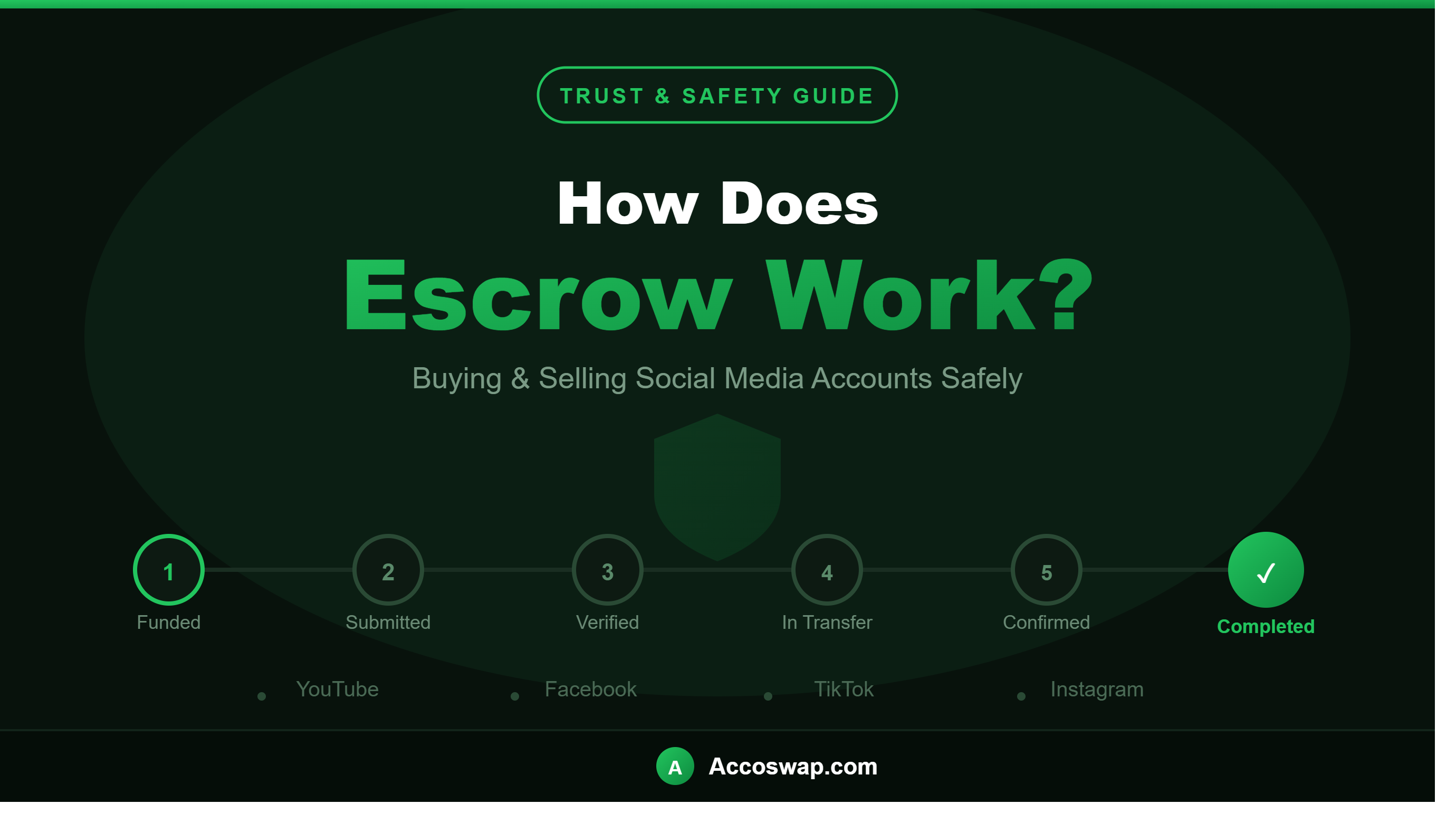
In an escrow-protected transaction, the buyer's payment is held securely by a neutral third party before anything is transferred. The seller only receives payment after the buyer has confirmed they have received and secured the account. Neither side can walk away with both the money and the account.
This single mechanism eliminates the most frequent and most damaging risk in this entire market. It does not eliminate every risk — fake followers, platform detection, and recovery attempts still require your own diligence — but it removes the risk of simply losing your money outright with nothing to show for it.
The Genuine Benefits That Make People Do This Anyway
Despite the risks, this market exists and continues to grow because the upside is real for the right buyer.
Time saved. Building a meaningful following from zero genuinely takes months or years. Buying an established account compresses that timeline dramatically.
Instant credibility. New accounts struggle for visibility and trust. An account with real history carries social proof that cannot be manufactured overnight.
Faster monetization. A channel or page that already has revenue, or is close to monetization thresholds, lets a buyer start earning much sooner than starting from nothing.
Business efficiency. For agencies and marketers managing multiple campaigns or clients, buying established accounts is often more practical than growing dozens of new ones from scratch.
These benefits are genuine, but they only materialize if the purchase is done carefully and the account is handled correctly afterward.
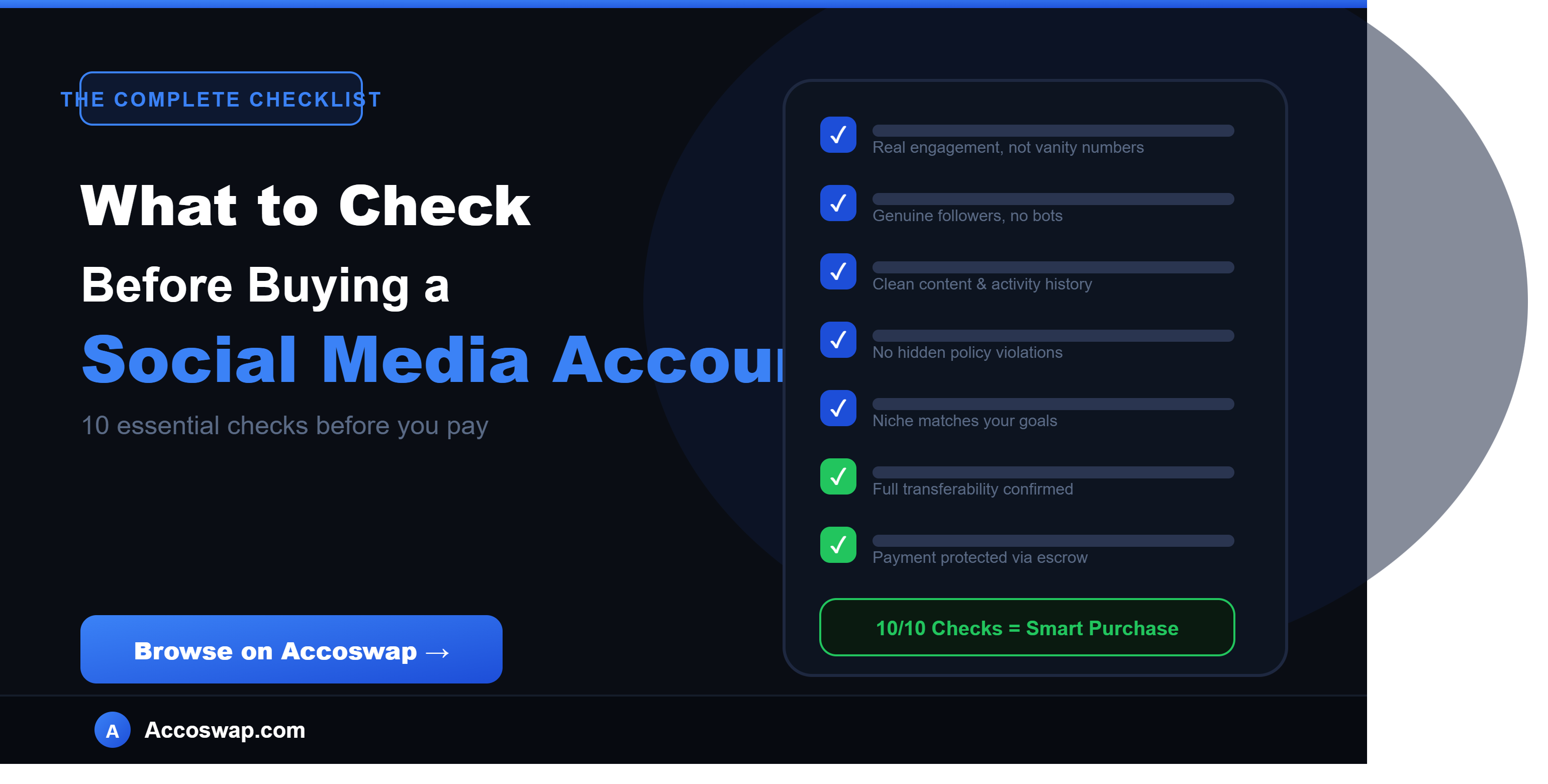
How to Buy Safely — The Practical Checklist
Here is the complete picture of what actually reduces your risk to a manageable, reasonable level.
Use a verified marketplace with escrow protection. This single decision eliminates the most common and most costly risk in the entire process. Never send payment directly to a seller outside of a protected system.
Verify engagement, not just follower count. Compare likes, comments, and views relative to the account size. Sample the actual followers for bot-like characteristics. Numbers alone tell you almost nothing.
Confirm you will receive the original email. This is essential for fully securing the account and preventing recovery attempts by the previous owner.
Secure the account immediately after the transfer. Change the password, update the email, update the phone number, and enable two-factor authentication before doing anything else.
Ease into activity gradually. Avoid dramatic, sudden changes to the account right after taking ownership. Natural, gradual activity reduces the chance of triggering automated platform flags.
Research the account's history thoroughly. Check for past niche shifts, policy violations, and content that does not align with your goals before committing to a purchase.
Keep all communication on the marketplace platform. This creates a documented record that protects you if a dispute ever becomes necessary.
How Accoswap Specifically Protects You
On Accoswap, every transaction — regardless of platform — follows the same protective principle: the buyer's payment is locked in escrow before anything is transferred, and it is only released once the transfer is verified and the buyer confirms they have full, secure control.
The specific mechanics differ by platform because each one transfers ownership differently. YouTube channels move through Google's Brand Account system with a mandatory 7-day security period. Facebook pages transfer through admin rights with no waiting period required. TikTok and Instagram accounts move through a secure credentials handover where the seller cleans the account first and the buyer immediately secures it upon receiving access.
In every case, the underlying protection is the same — your money or your account is never exposed without a safety net at any stage of the process.
Frequently Asked Questions
Is buying social media accounts legal?
In most countries, buying and selling social media accounts is not a criminal matter — it is a private transaction between two parties. However, it typically conflicts with the platform's own terms of service, meaning the platform itself does not officially support or protect the transfer, even though the transaction is not illegal.
In most countries, buying and selling social media accounts is not a criminal matter — it is a private transaction between two parties. However, it typically conflicts with the platform's own terms of service, meaning the platform itself does not officially support or protect the transfer, even though the transaction is not illegal.
What is the single biggest risk when buying an account?
Losing your money in a direct, unprotected deal where the seller never delivers or simply disappears after payment. This is also the risk that is most completely solved by using an escrow-protected marketplace.
Losing your money in a direct, unprotected deal where the seller never delivers or simply disappears after payment. This is also the risk that is most completely solved by using an escrow-protected marketplace.
Can my account get banned after I buy it?
There is some risk of this, particularly if the transfer is handled carelessly or the account behaves suspiciously afterward. This risk is reduced significantly by securing the account properly and avoiding sudden, dramatic changes in the days immediately following the transfer.
There is some risk of this, particularly if the transfer is handled carelessly or the account behaves suspiciously afterward. This risk is reduced significantly by securing the account properly and avoiding sudden, dramatic changes in the days immediately following the transfer.
Is it safer to buy an aged account?
Generally yes. Aged accounts carry more established trust with platform algorithms and tend to face less scrutiny than brand new accounts, which reduces — though does not eliminate — the risk of triggering automated restrictions.
Generally yes. Aged accounts carry more established trust with platform algorithms and tend to face less scrutiny than brand new accounts, which reduces — though does not eliminate — the risk of triggering automated restrictions.
Should I avoid buying accounts entirely?
That depends on your risk tolerance and goals. If you buy carefully through a protected platform, verify everything, and secure the account properly afterward, the practical risk becomes quite manageable. If you are buying through unprotected direct deals, the risk is genuinely high and avoidable mistakes are common.
That depends on your risk tolerance and goals. If you buy carefully through a protected platform, verify everything, and secure the account properly afterward, the practical risk becomes quite manageable. If you are buying through unprotected direct deals, the risk is genuinely high and avoidable mistakes are common.
What is the one thing I should never skip?
Escrow protection. Regardless of anything else you do or do not verify, never send payment directly to a seller outside of a system that holds the funds securely until the transfer is confirmed complete.
Escrow protection. Regardless of anything else you do or do not verify, never send payment directly to a seller outside of a system that holds the funds securely until the transfer is confirmed complete.
The Bottom Line
Buying a social media account is not inherently dangerous, and it is not inherently safe either. It is a transaction with real risks that are almost entirely manageable when you understand them and take the right precautions.
The biggest, most damaging risk — losing your money outright — is solved by using escrow protection and never dealing directly outside of it. The remaining risks — fake engagement, account recovery, and platform detection — are managed through careful verification and proper security practices after the transfer.
Done the right way, with the right protections in place, buying an established account can be a genuinely smart shortcut. Done the wrong way, it can be an expensive lesson. The difference is entirely in your hands.
On Accoswap
Ready to act on this guide?
Tags: