How Much Is My Telegram Channel Worth? A Pricing Guide for 2026
Someone probably offered you a number that felt too low. Or you saw a channel with fewer subscribers than yours sell for triple what you expected. Both experiences are common, and both come from the same misunderstanding: subscriber count is the least reliable way to price a Telegram channel.
Buyers aren't paying for a number on your profile. They're paying for what that number can do — how many people actually see each post, whether those people are real, and whether they're worth advertising to. This guide walks through the actual inputs that set a price, so you can land on a defensible number instead of guessing.
Why Subscriber Count Alone Is a Bad Price Signal
A channel with 50,000 subscribers and 500 average views per post is worth less than a channel with 15,000 subscribers and 6,000 average views per post. Every experienced buyer knows this, which is why quoting subscriber count as your main selling point tends to get a lukewarm response.
Subscriber count tells a buyer the ceiling. It doesn't tell them the floor — how many of those subscribers are still active, muted the channel, or never existed in the first place. Buyers price the floor, not the ceiling.
This is also why two channels of identical size can sell for wildly different amounts. The gap isn't mysterious once you look past the headline number.
Engagement: The Number That Actually Sets the Price
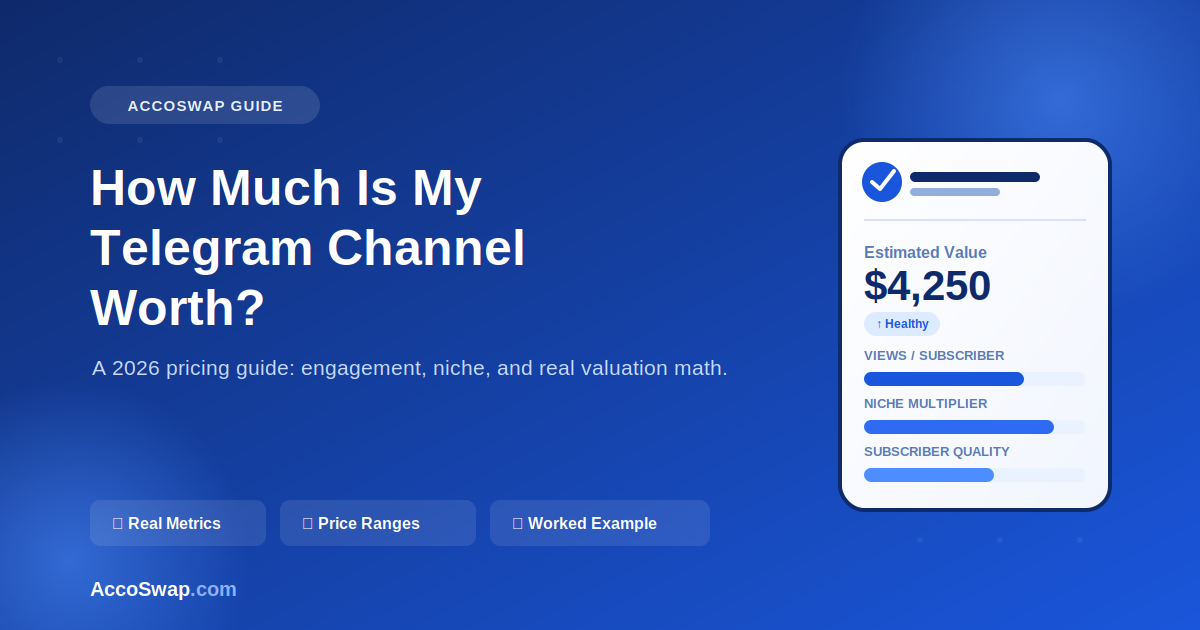
The single most useful metric is average views per post as a percentage of subscribers, sometimes called the view-through rate.
Rough ranges buyers use as a gut check:
- 15–30%+ views-to-subscribers: strong, healthy engagement. This is where most well-run niche channels land.
- 5–15%: average. Not alarming, but not a premium channel either.
- Under 5%: weak. Suggests a large portion of subscribers are inactive, muted, or fake.
- Above 40–50% on a channel that also has unusually high subscriber counts relative to its age: sometimes a good sign, but worth double-checking — it can also indicate a smaller, tighter audience than the subscriber count implies (bots inflate subscriber count but can't inflate views the same way).
These are typical patterns, not fixed thresholds — a niche channel with a die-hard following can beat 30% easily, while a channel that grew through cheap subscriber ads might sit at 3% forever.
Buyers will ask for view stats on your last 10-20 posts before they take subscriber count seriously at all. Have this ready.
Niche Multipliers: Why Topic Matters More Than Size
This is where people most often underestimate or overestimate their channel.
High-value niches — crypto, trading, forex, personal finance, business/entrepreneurship, SaaS, affiliate marketing — sell for noticeably more per subscriber than general audiences, often several times more at similar engagement levels. The reason is simple: these audiences are worth more to advertisers and are more likely to convert on offers, so buyers can monetize them faster and harder.
Mid-value niches — tech news, productivity, education, health and fitness, local city channels — sit in the middle. Real value, but a smaller pool of advertisers willing to pay premium rates.
Lower-value niches — general entertainment, memes, movie/TV clip channels, generic news aggregation — usually sell for the least per subscriber, even with excellent engagement. There's more supply of these channels and fewer advertisers paying a premium for that audience.
None of this means an entertainment channel isn't sellable. It means the same 20,000 subscribers in a finance channel will typically fetch a meaningfully higher price than 20,000 subscribers in a meme channel, all else equal.
Subscriber Quality: How Buyers Spot Bought Members
Serious buyers check this before making an offer, and it can tank a valuation fast if it's bad.
What they look for:
- A sudden subscriber spike with no matching views spike. If you gained 10,000 subscribers in a week but views per post didn't move, that's a red flag for a bought batch.
- Subscriber growth that doesn't match posting frequency or content quality. Organic growth usually correlates with active periods.
- Generic or bot-pattern usernames among visible members, if the channel type shows a member list.
- Geography mismatch — a channel that should logically draw a US/UK audience but shows engagement patterns typical of subscriber-farm regions.
If a buyer suspects bought subscribers, they won't just discount the price a little. They'll often price the channel as if the padded subscribers don't exist at all, which can cut the number by half or more. Being upfront about any past subscriber ads you ran (and separating that from organic growth) tends to preserve more value than getting caught.
Monetization History and Provable Revenue
A channel that's already making money is worth more than one with theoretical potential, and the gap is usually large.
If you've run sponsored posts, affiliate links, or a paid subscription tier, gather the actual numbers: what you charged, how often, and what it converted to. Screenshots of payment records, ad rate cards, or affiliate dashboard earnings do more for your price than any subscriber count.
Unproven potential ("this could easily run ads for $200 a post") gets heavily discounted by buyers, because they're the ones who have to prove it after the purchase. Proven revenue gets closer to full credit, because the buyer is bulk-buying a result, not a bet.
Audience Geography: Where Your Subscribers Live Matters
A US/UK/Western Europe-heavy audience is worth more than the same size audience concentrated in low-CPM regions, because advertiser rates for those regions differ significantly.
This is one of the more overlooked factors. Two channels with identical subscriber counts, engagement rates, and niches can still land on different prices purely because one audience is geographically more valuable to advertisers than the other.
If you have any audience analytics — even informal ones from a linked bot or survey — geography is worth including in your pitch to a buyer.
Channel Age, Consistency, and Whether People Follow the Topic or You
Older channels with a steady, uninterrupted posting history generally command a premium over new channels with the same stats, because they've proven durability.
Consistency matters almost as much as age. A channel that posts daily for two years reads very differently to a buyer than one that posted heavily for three months, went dark for a year, then restarted.
One more distinction buyers actively check: does the audience follow the topic, or does it follow you personally? A channel built around your face, voice, or personal brand is harder to sell profitably, because the audience may churn once ownership changes and the personality disappears. Topic-driven channels (a niche, a format, a type of content) transfer value more cleanly.
Worked Example: Same Subscribers, Very Different Prices
Channel A: 20,000 subscribers, crypto/trading niche, 22% views-to-subscriber ratio, two years old, consistent daily posting, provable sponsored-post income, mostly US/UK audience, no suspicious subscriber spikes.
Channel B: 20,000 subscribers, general meme/entertainment niche, 4% views-to-subscriber ratio, six months old, gained 8,000 subscribers in one unexplained week, no monetization history, audience concentrated in low-CPM regions.
Same subscriber count. Channel A will typically sell for several times more than Channel B, sometimes an order of magnitude more, because almost every underlying factor points the same direction: real engagement, valuable niche, proven revenue, valuable geography, and no red flags. Channel B has the opposite profile on nearly every axis that actually drives price.
If you want a live sense of how this plays out across niches and sizes, browsing current Telegram channel listings gives a reasonable market snapshot of what similar profiles are asking.
What Tanks a Valuation Fast
A few specific things cause buyers to lowball or walk away entirely:
- Long inactive stretches, even if the channel later recovered. Buyers assume it can happen again.
- A mass unsubscribe event, especially right after a promo push or giveaway — it signals the growth wasn't genuine interest.
- Reused or stolen content, which risks copyright strikes and platform penalties for the new owner.
- Any history of ownership disputes, prior escrow issues, or unclear provenance of how you acquired the channel if you weren't the original creator.
Any one of these can knock 30-50% or more off an otherwise reasonable price, because they shift risk onto the buyer.
Once you've got a realistic number in mind, this guide to selling a Telegram channel covers how the actual transfer and payment process works, so the deal matches the price you've settled on.
FAQ
What's a simple starting formula for pricing my channel?
There isn't a single fixed formula, but most experienced sellers start from engaged subscribers (active viewers, not total count) combined with niche and monetization proof, then adjust up or down for geography, consistency, and red flags. Treat any quick formula as a starting estimate, not a final number.
There isn't a single fixed formula, but most experienced sellers start from engaged subscribers (active viewers, not total count) combined with niche and monetization proof, then adjust up or down for geography, consistency, and red flags. Treat any quick formula as a starting estimate, not a final number.
Does channel age by itself add value?
Somewhat, but mostly as a proxy for trust and consistency. A five-year-old channel that's been dormant for the last two isn't worth more than a two-year-old channel that's been active the whole time.
Somewhat, but mostly as a proxy for trust and consistency. A five-year-old channel that's been dormant for the last two isn't worth more than a two-year-old channel that's been active the whole time.
Should I disclose that I ran subscriber ads in the past?
Yes. Buyers usually find inconsistent growth patterns anyway, and being upfront about it lets you separate organic value from padded numbers instead of losing credibility on the whole valuation.
Yes. Buyers usually find inconsistent growth patterns anyway, and being upfront about it lets you separate organic value from padded numbers instead of losing credibility on the whole valuation.
Is a channel with high subscribers but low engagement worth selling at all?
It's still sellable, just at a lower price point reflecting real reach rather than headline numbers. Being transparent about the engagement rate upfront usually gets a fairer offer than letting a buyer discover it during due diligence.
It's still sellable, just at a lower price point reflecting real reach rather than headline numbers. Being transparent about the engagement rate upfront usually gets a fairer offer than letting a buyer discover it during due diligence.
On Accoswap
Ready to act on this guide?
Tags: